Research
Building predictive models that know when they don't know.
Fast models are useful because they discard information, and dangerous for the same reason. A reduced-order model runs in a fraction of the time of the simulation it replaces; a pretrained foundation model emulates physics it was never shown. Both return a confident number, and neither reports how much of that number is an artifact of the shortcut that made it fast.
Our work puts the uncertainty in the model’s own structure rather than in a correction bolted onto its outputs, then calibrates it against the errors the model makes. See Projects for the systems these methods were built for.
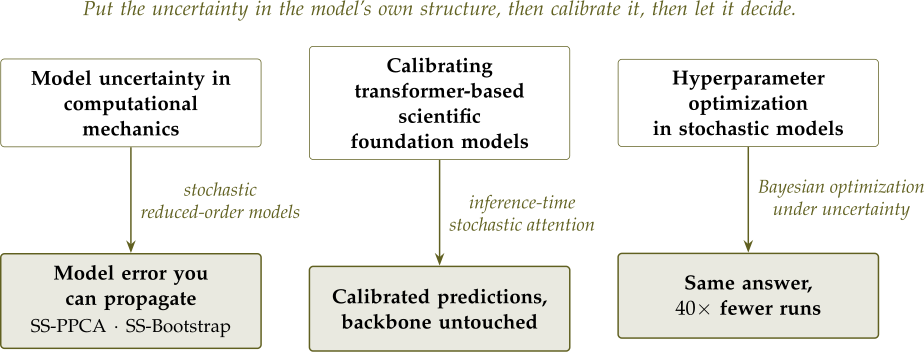
Model uncertainty in computational mechanics
The usual remedy for reduction error is to fit a correction to the model’s outputs. That patches the symptom and leaves the cause in place: the error originates in the basis the model was projected onto.
We make that basis uncertain instead. It becomes a distribution over subspaces rather than one fixed choice: first parametrically through probabilistic PCA, then nonparametrically through the bootstrap, which drops the Gaussian assumption and works from the empirical distribution directly. The reduction error then propagates through to the prediction rather than disappearing into it, including at locations and quantities never observed during training.
Applied to shock response of a space structure · Stochastic Subspace via Probabilistic PCA, Computational Mechanics · code
Nonparametric Stochastic Subspaces via the Bootstrap, ASCE-ASME J. Risk Uncertainty Eng. Syst. · code
Calibrating transformer-based scientific foundation models
Foundation models are becoming general-purpose surrogates for weather, climate and mechanics, and they are deterministic point predictors. The groups adopting them usually cannot change that: the weights are vendor-supplied, export-controlled, or simply too expensive to retrain, and the standard remedies all assume access to the backbone.
We get calibrated uncertainty out of a model we are not allowed to touch, at inference time, with every pretrained weight left exactly as it was. It applies to fine-tuned backbones as well as pretrained ones, which is what scientific workflows actually run on. A group can adopt someone else’s foundation model and still know when to believe it, without a training budget of their own.
Applied to calibrated weather forecasting · Calibrating Scientific Foundation Models with Inference-Time Stochastic Attention (under review)
Hyperparameter optimization in stochastic models
None of the above is usable if calibrating it costs more than the simulation it replaces. Stochastic models carry hyperparameters that must be tuned, every evaluation of them is itself random, and the standard fix is to average that randomness away by sampling repeatedly, which is the cost you were trying to avoid.
We treat the objective’s own uncertainty as part of the objective rather than as noise to suppress. It reaches the same parameter with 40× fewer evaluations than scalar bounded optimization, and 15× fewer than standard Gaussian-process Bayesian optimization. That is the difference between a method that works in a paper and one that runs inside somebody’s workflow.
Applied to shock response of a space structure · Bayesian Optimization under Uncertainty for Training a Scale Parameter in Stochastic Models · code
Projects · Publications · Code · Talks